Proxmox
TODOcpu48 x Intel(R) Xeon(R) CPU E5-2676 v3 @ 2.40GHz (2 Sockets)
ram256 GB (16x SK Hynix 16GB PC4-17000 (DDR4-2133) ECC REG)
bootzfs mirror of 2x 200GB Intel SSD (MK0200GCTYV)
nicsTODO
gpuNVIDIA Tesla T4 16GB GDDR6
The prod homelab. Total cost: unknown, and we keep it that way for everyone's sake.
homelab proxmox zfs
Work in progress. The rack layout, servers and pools are still sample values.
This is my prod lab: the hardware I actually depend on day to day. I have plenty of other servers and drives for testing and tinkering, but they don’t make this list. Experiments get their own projects, and land in the changelog here once they go into service.
Almost everything runs on a single, beefy Proxmox host. It manages the ZFS pools directly.
Most of the spinning drives are Seagate Exos, in a mix of sizes. The main SSD arrays are built from SAMSUNG MZILS3T8HCJM 3.84TB PM1633 12Gbps SAS 2.5” SSDs.
70% full · 115 TiB until 85%
| raidz2 | 10× 20 TB | 200 TB |
| raidz2 | 10× 20 TB | 200 TB |
| raidz2 | 10× 18 TB | 180 TB |
| raidz2 | 10× 18 TB | 180 TB |
| raidz2 | 10× 16 TB | 160 TB |
| raidz2 | 10× 16 TB | 160 TB |
47% full · 12.4 TiB until 85%
| mirror | 2× 18 TB | 36 TB |
| mirror | 2× 18 TB | 36 TB |
34% full · 3.5 TiB until 85%
| mirror | 2× 3.84 TB | 7.68 TB |
| mirror | 2× 3.84 TB | 7.68 TB |
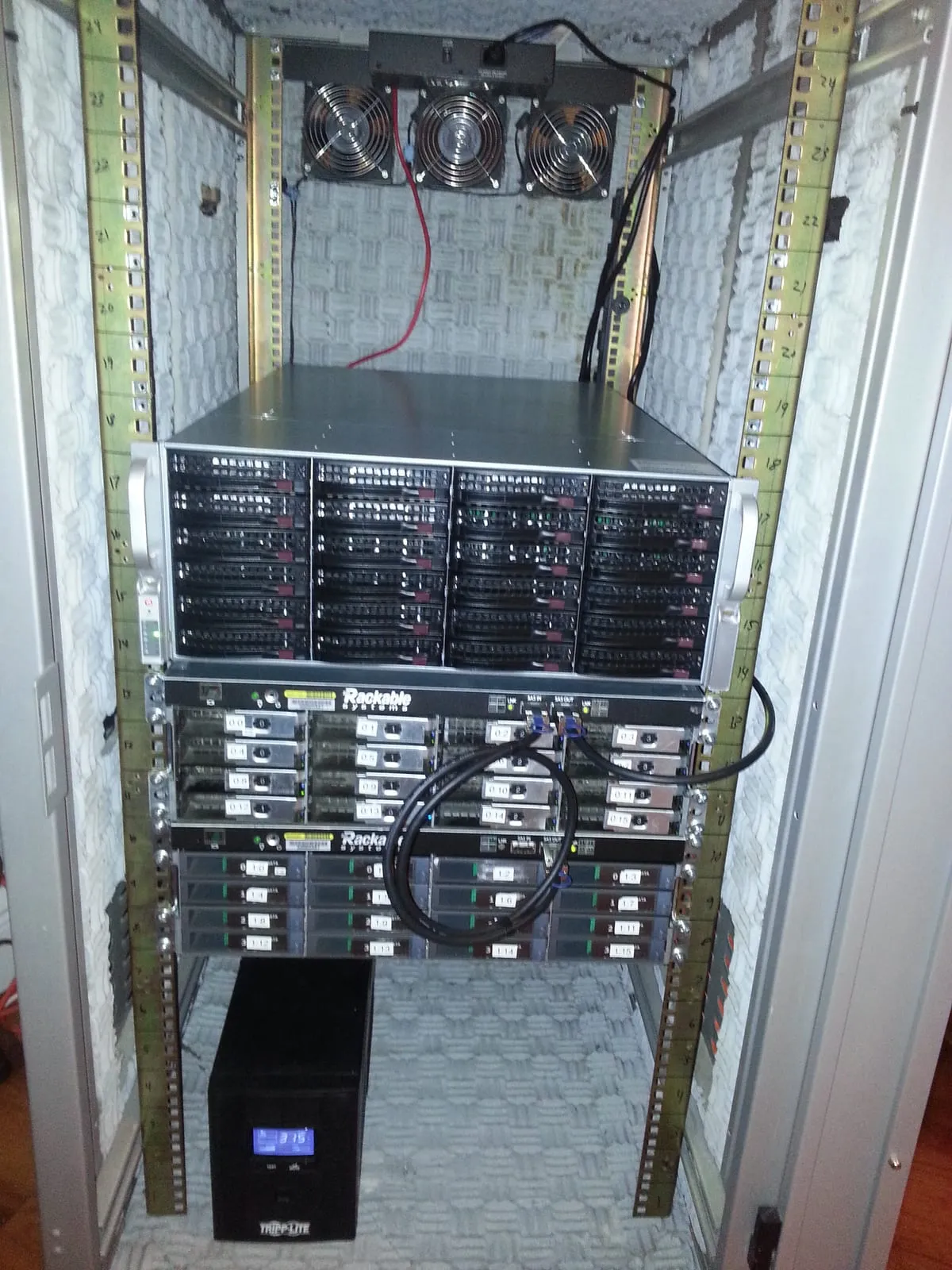
A 3U UPS sits at the bottom of the rack, and the rack has its own dedicated 240 V, 30 A circuit.
zfs list -o name,used,avail. zpool list and the
Proxmox ZFS panel show raw space, parity included.Energy prices in my area kept climbing, so I spent a while consolidating a lot of dedicated servers into as few as possible, ending up with one Proxmox host. My dedicated TrueNAS box went too: its ZFS pools moved over to the Proxmox host, which now manages them directly.
I could cut the power draw further with a newer motherboard, CPU and RAM, but most of it actually comes from the hard drives spinning 24/7. Right now new hardware would cost more than it would save.
Back to a full-size 42U rack, this time on its own dedicated 240 V, 30 A circuit. At its peak, a good amount of it was filled.
The old 26U rack is still around. It holds servers I don’t actively use, which is a good way to store them without taking up more space.
From my post in HardForum’s storage showoff thread. Four servers by now, all on 10 Gb networking:
Both Proxmox servers ran a mix of LXCs and VMs, depending on the workload. The main media array was SnapRAID and MergerFS over 19x 16TB, 3x 10TB and 3x 8TB drives, 358 TB raw. On top of that I had 24x 4TB drives and a handful of 6TB drives waiting for something to do.
I picked this rack up in early fall 2014 from someone who was getting rid of their home setup. It has a glass door, sound damping, and exhaust fans for cooling. It’s only 26U, but it weighs well over 100 lb empty, so it had to be fully taken apart every time I moved, starting with the move to another NYC apartment in January 2015. I still have it.
This is when I really ramped up. By then I was all in on Supermicro chassis, which made life easy: the drive sleds are all the same, so drives can move between servers as needed. The large storage arrays started here, along with real clusters to run storage and apps.
I’d started building clusters around 2015, and over these years I built and ran most of the usual ones: Proxmox clusters, Kubernetes, Ceph and Docker Swarms, as well as some dedicated SAN servers (I forget what those ran). I like overkill, but for a personal homelab even that was too much. They were fun to build and I learned a lot from each one. They were also completely unnecessary for what I actually run.
The numbers I have from this time come from old HardForum posts: the two below, from when the rack was new, and the 2020-12 one above. The years in between went mostly unrecorded.
From my post in the newer HardForum showoff thread, five days after the last one and in a new NYC apartment. Same server, reshuffled: 87T total, 63T of it in the one Supermicro case.
What changed from 2014-12:
| Array | Drives | Chassis |
|---|---|---|
| 1, RAID 6 | 6 x 2T Samsung (HD204UI) | SC846E16 |
| 2, RAID 6 | 8 x 3T Seagate (ST3000DM001) | middle SE3016 |
| 3, RAID 6 | 12 x 4T WD Red (WD40EFRX) | SC846E16 |
| Downloads | 1 x 3T Seagate (ST3000DM001) | SC846E16 |
The bottom SE3016 was empty for now. I also kept an unused 2T, 3T and 4T drive on hand to replace any that failed in the arrays.
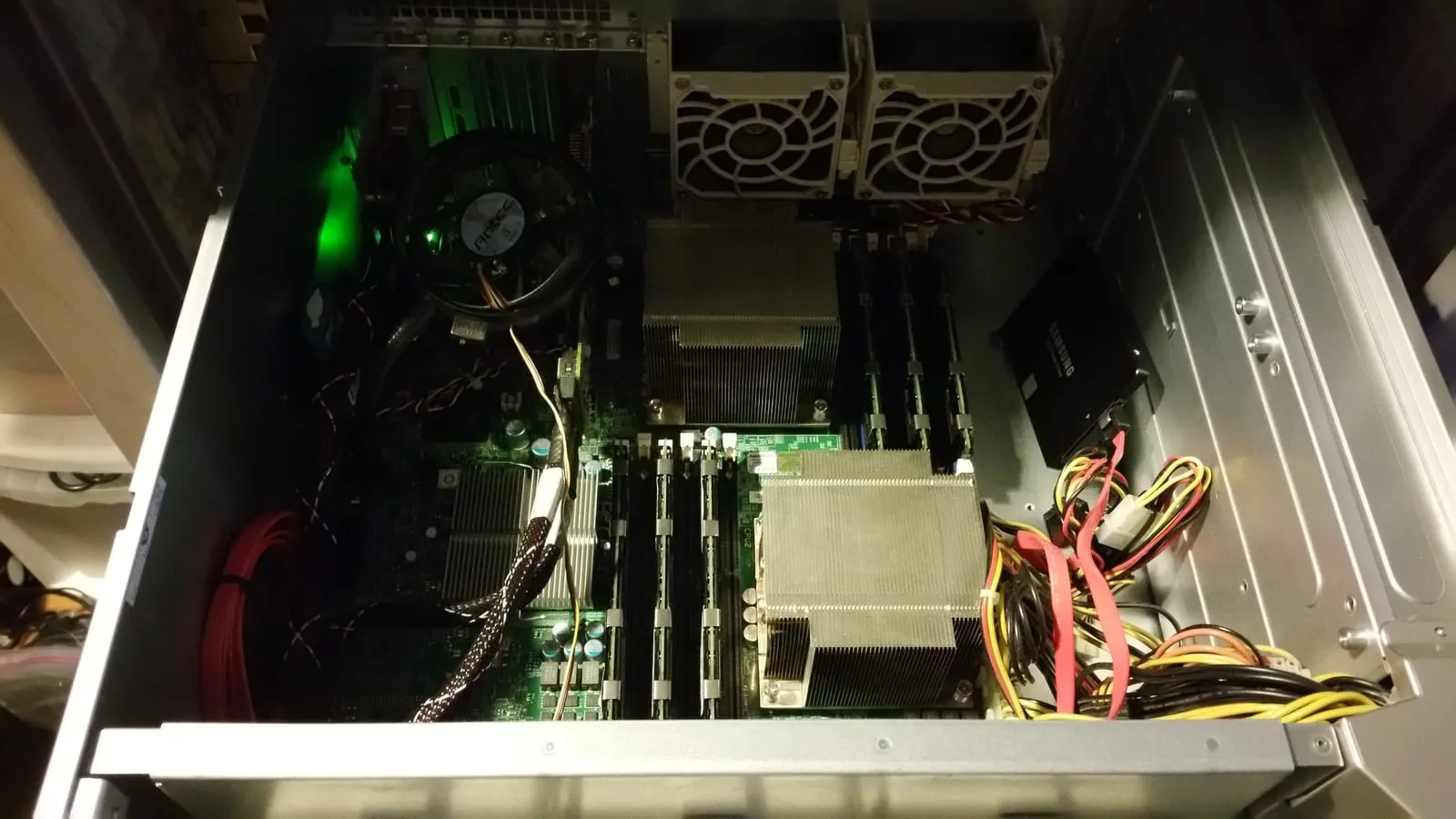
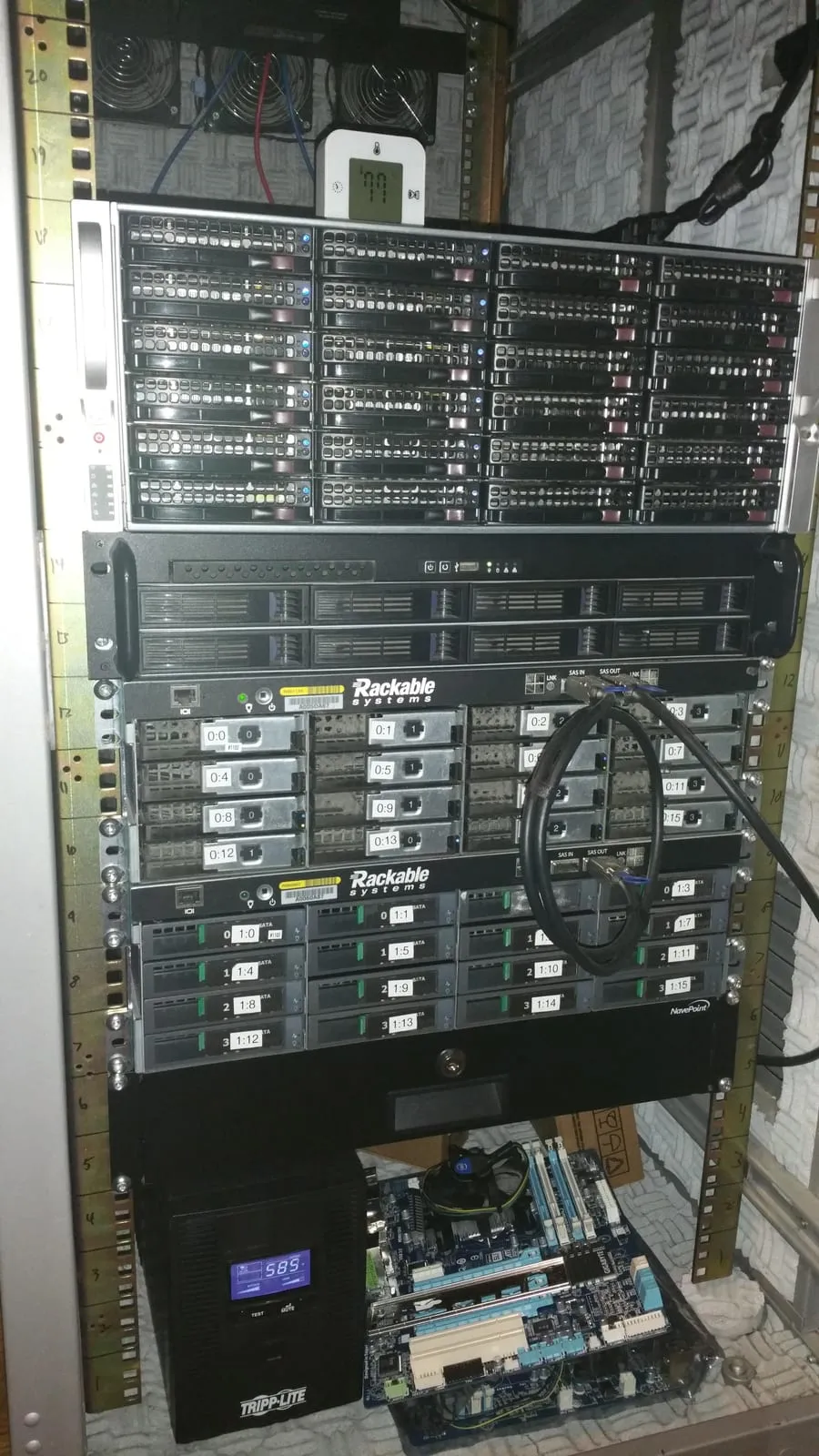
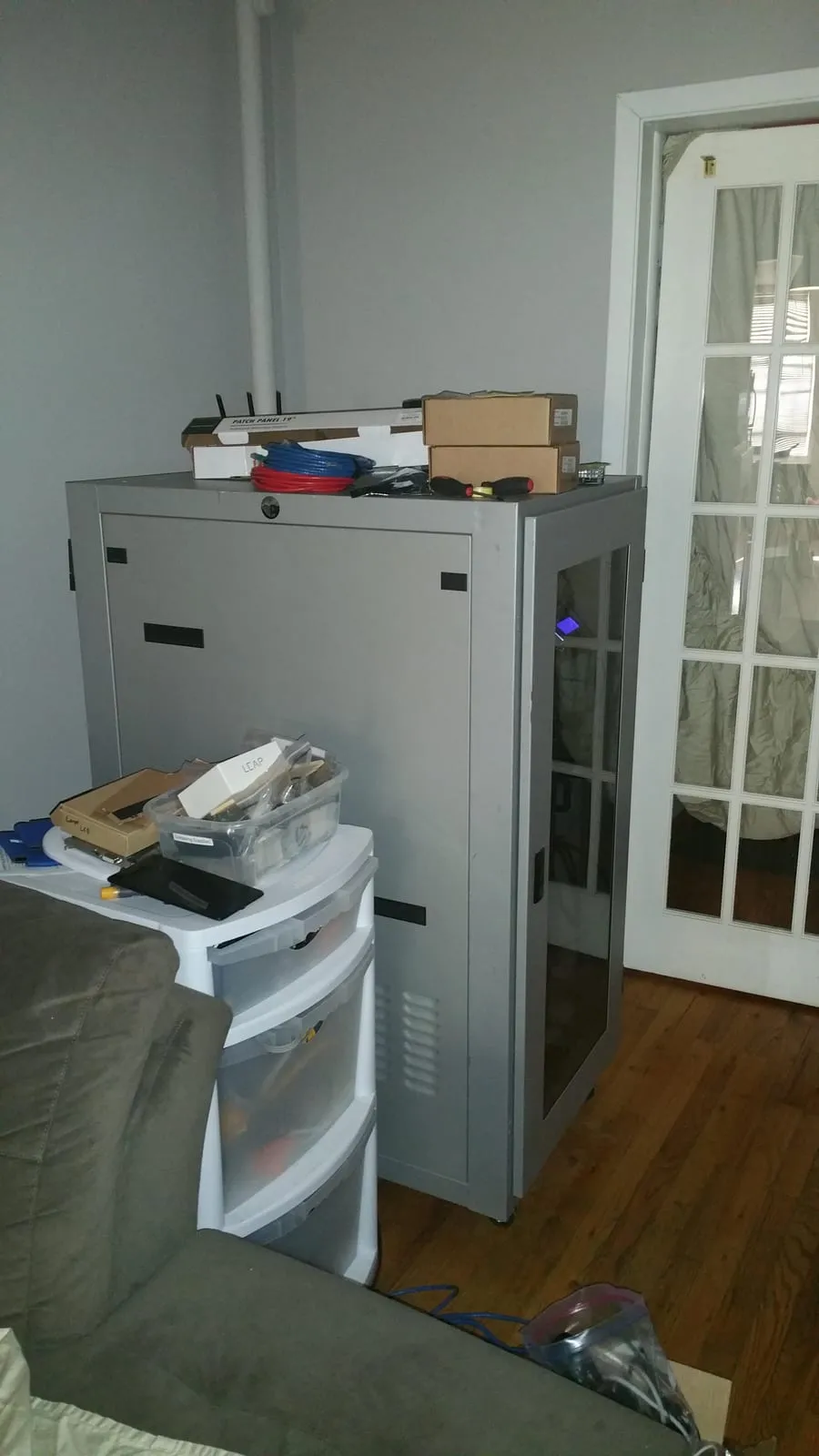
The post also had a video of the noise difference, but it was on vid.me, which is long gone.
From my post in HardForum’s storage showoff thread. One Windows Server 2012 box ran Plex and my Usenet downloads, with two SAS expander chassis for more drives: 86T raw, 59.073T usable. I posted it in December, but most of this setup dates from early 2014.
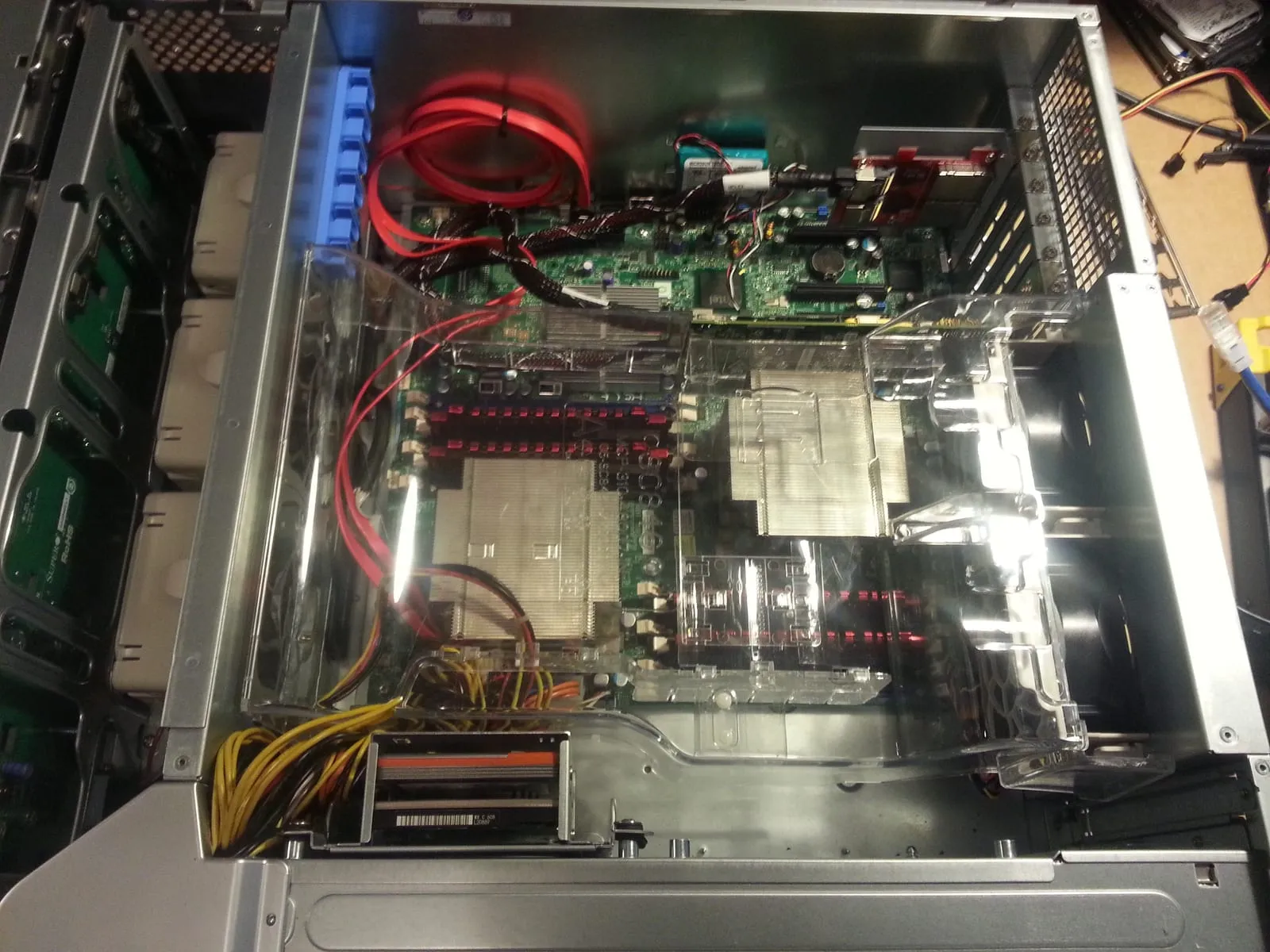
The drives were split into three RAID 6 arrays, plus a RAID 1 to download to:
| Array | Drives | Chassis |
|---|---|---|
| 1, RAID 6 | 8 x Samsung Spinpoint F4EG 2T (HD204UI) | SC846E16 |
| 2, RAID 6 | 8 x Seagate Barracuda 3T (ST3000DM001) | middle SE3016 |
| 3, RAID 6 | 10 x WD Red 4T (WD40EFRX) | middle SE3016 |
| RAID 1 | 2 x Seagate Barracuda 3T (ST3000DM001) | bottom SE3016 |
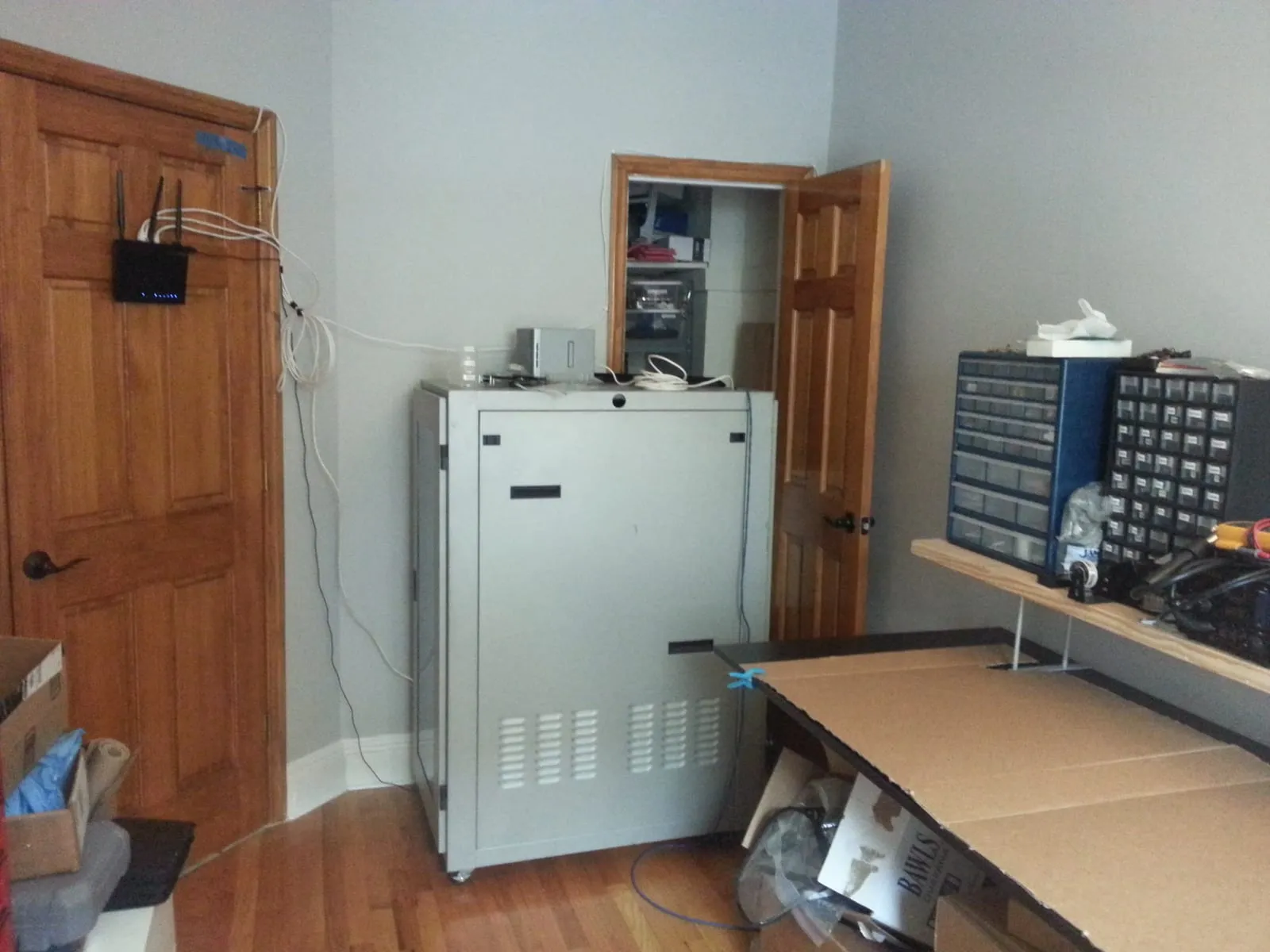
That small gray box on top of the rack is the WD ShareSpace from 2008, my first NAS. It was retired by then, but I kept it since it was my first. The closet behind the rack is where the DIY shelf rack lived.
In early 2014, I moved into an apartment in NYC. The 42U rack stayed in my friend’s basement, not by choice: it physically wouldn’t fit.
The closet was weirdly deep and very narrow, so I built my own “rack”: a plywood base with casters bolted on, and one of those metal shelving units with wood shelves. The servers just sat on top of each other, and the whole thing rolled in and out of the closet. Sometimes you make do with what you have.
I ran that until early fall 2014, when I got a real rack again.
It didn’t take long before I had a 42U open-frame, four-post rack in my dorm room, with a few enterprise servers in it, some kind of Dell R-series I think. My roommate and I were both getting into self-hosting, and we each had our own servers in it. Did we need a 42U rack? No, but it was cheap, and light since it was open-frame. And yes, that means enterprise servers running almost 24/7 in a dorm room. It kept causing problems for the college’s network team; let’s just say we got to know each other pretty well over those years.
I also started getting into hardware RAID controllers, and we picked up some Rackable SE3016s: 3U, 16-bay JBODs that ran over SAS-1 links and could be daisy-chained together. Two of them ended up in the 26U rack, under the Supermicro in the 2014 photos. I think I still have those chassis.
Toward the end of college, my friend got a house, and we moved to two proper 42U racks with sides and doors in his basement. By then we each had a handful of servers and a few storage boxes.
Before this, my data lived on a few external drives and random internal drives, swapped through eSATA and USB docks and a few internal bays. No backups, no RAID. Then a full 640 GB drive died. Nothing that couldn’t be “replaced”, thankfully, but at the internet speeds of the time it still hurt a lot.
At the time, a few WD 640 GB drives and a 750 GB Seagate Barracuda held all of my data. That was mostly “ripped DVDs”, plus a collection of rainbow tables I generated myself on a small cluster of old desktops back in the early 2000s. For educational purposes, of course.
So I started looking into better ways to store data, and learning about the different types of RAID. My first dedicated NAS was a WD WDA4NC40000N 4TB ShareSpace Network Storage, bought when it came out in 2008. It shipped with four 1 TB WD Caviar Green drives. About the only bigger drive you could buy was Seagate’s 1.5 TB Barracuda, which had come out a couple of months earlier. It retailed for $999.99.
I was already deep into computers by then, but if the homelab has a day one, it’s this NAS. It came with me to college as my first real RAID storage device, and it all grew from there.